
Is Your Business Appearing in ChatGPT, Gemini & Other AI Answers?
By
Key Takeaways
- AI answers are changing customer behaviour via tools like ChatGPT and Gemini for recommendations
- Traditional SEO still matters. Google remains the dominant driver of search referral traffic
- AI visibility is more selective. Your business may need to be one of only a few brands cited or recommended
- Information is critical. AI systems need clear, detailed content to understand what you offer and how you compare
- Corroboration matters. Reviews, citations and consistent third-party signals help AI systems verify your claims
- The goal is simple: make your business easier to understand, easier to verify and easier to recommend
Search is changing again.
For years, the SEO goal for many businesses has been relatively straightforward: appear prominently in Google when potential customers search for your products or services.
That still matters. In fact, it matters a lot - data from Similarweb suggests Google referrals outstripped referrals from AI platforms combined by almost 170x in June 2025. Yet, the way people search is beginning to shift, and while traditional SEO remains essential, businesses also need to start thinking about how they appear in AI-generated answers and recommendations.
More users are now asking AI tools such as ChatGPT, Gemini and Perplexity for direct recommendations:
💬 “Where should I buy…?”
💬 “Who is the best provider for…?”
💬 “What company should I choose?”
That represents a meaningful change in the customer journey.
In a traditional Google search, a user might compare several websites, read reviews, check prices, open multiple tabs and continue researching before making a decision.
With AI search, a lot of that research can be compressed into the answer itself. The AI tool may compare options, summarise the market, identify trust signals and recommend a smaller number of businesses before the user ever reaches a website.
That makes AI visibility increasingly important.
It also makes it more selective.
AI answers do not always present users with a long list of options in the way a standard search results page might. Often, they surface only a handful of brands they can understand, compare and justify recommending.
So the question for businesses becomes:
Is your brand giving AI systems the information and evidence they need to recommend you?
AI visibility starts with strong SEO foundations
A lot of the discussion around AI optimisation can make it sound like something completely new. Terms like GEO, or Generative Engine Optimisation, and AEO, or Answer Engine Optimisation, are now increasingly common in the digital marketing lexicon.
In reality, many of the fundamentals are familiar. Google’s own guidance states that, from Google Search’s perspective, "optimising for generative AI search is optimising for the search experience, and thus still SEO". Its advice is not to chase a separate set of tricks, but to apply strong SEO fundamentals to generative AI search: helpful content, clear technical structure, accurate business information and a website that can be properly crawled, indexed and understood.
Therefore, traditional search engine optimisation methods should not be ignored. A fast, well-structured website matters. Clear content matters. Strong technical SEO matters. Helpful product or service information matters. Reviews, authority, brand consistency and user experience all matter.
If you have been investing properly in SEO, content and your wider digital presence, you are already much closer to being visible in AI search than a business that has neglected those foundations.
But there are two areas that are becoming especially important:
Information and corroboration.
Information: can AI systems understand what you offer?
AI tools need clear information to work with.
That sounds obvious, but many business websites still leave important questions unanswered.
What exactly do you offer? Who is it for? Where do you operate? What makes your product or service different? How does your pricing, delivery, process or experience compare with alternatives? What proof is available to support your claims?
If your website does not give AI systems enough useful information, you may not be part of the answer at all.
This does not mean filling pages with repetitive keywords. It means creating genuinely helpful content that explains your business clearly, answers real customer questions and gives search engines and AI systems the context they need.
For Richardson’s Jersey Royals, a client we have worked closely with for several years, this meant strengthening content around the product itself, the buying process, delivery, pricing, seasonality, freshness and customer value.
We created a dedicated guide to Jersey Royals, designed to answer the kinds of questions people are likely to ask when researching the product. We also overhauled an existing lynchpin information page that was already attracting valuable Google traffic, making sure it provided richer and clearer information around the business and its offer.
The aim was to make it easier for AI systems to understand and compare Richardson’s offering by improving the depth, clarity and usefulness of the information available on the website.
Corroboration: can AI systems verify what you say?
Information is only one part of the picture.
AI systems can draw on an increasingly broad range of channels when analysing brands, not just websites and company-owned surfaces, but also external signals that help support, verify or challenge what a business says about itself.
That is where corroboration matters.
For many businesses, this might include independent reviews, third-party listings, media coverage, citations, social proof, structured data, consistent information across channels and a broader digital footprint.
In Richardson’s case, one clear gap was independent review visibility.
The business already had many happy customers. Jersey Royals are a seasonal product with a loyal customer base, and Richardson’s had the customer experience to support strong reviews. But that satisfaction was not being captured in a structured, independent way that could support wider search and AI visibility.
So we set up a Trustpilot account and created an automated WooCommerce review request workflow. After customers placed an order, they were automatically invited to share their experience.
Within six weeks, Richardson’s had received 178 Trustpilot reviews, mostly praising the company’s product and overall ordering and delivery service.
That created a valuable new trust signal. It gave potential customers independent reassurance, and it gave search engines and AI systems another source of evidence to consider when assessing the business.
This is an important point.
AI visibility is not just about the words on your website. It is also about the credibility of the wider digital footprint around your brand.
What happened next?
The results have been a useful example of where search is heading.
Across AI tools including Perplexity, Gemini and ChatGPT, Richardson’s Jersey Royals has been surfaced in relevant buying conversations around Jersey Royals online.
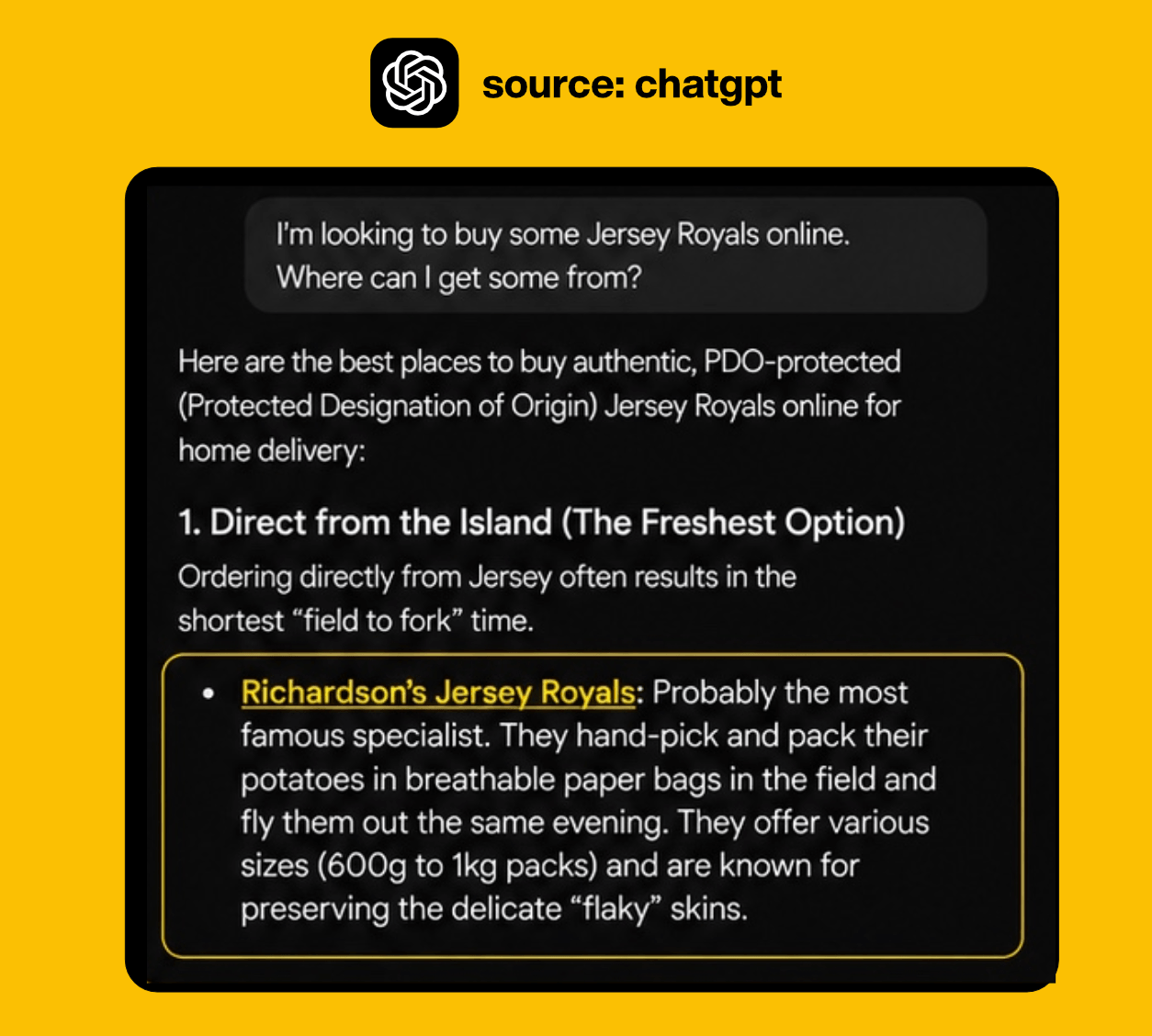
The answers have referenced areas such as supplier comparisons, freshness, direct delivery and independent review signals.
That does not mean any business can control exactly what an AI tool will say. No business or digital agency can guarantee that. AI answers vary by platform, prompt, timing, location and the sources available to the model. Not only that, but AI models are continuously evolving, and with that, the parameters they use to determine who they cite in answers.
However, what the exercise did show was the value of giving these systems better material to work from. As these systems evolve, that underlying principle is likely to remain important.
✅ Clearer information.
✅ Better structured content.
✅ Stronger trust signals.
✅ A wider set of credible sources that support what the business says about itself.
That is the direction SEO is moving in.
For more on the results of our AI visibility exercise for Richardson's Jersey Royals, please see our LinkedIn post.
AI visibility is not a replacement for SEO
It is tempting to treat AI optimisation as a completely separate discipline.
We do not think that is the right way to look at it.
AI visibility builds on the same foundations that have always mattered in good digital strategy: useful content, technical quality, brand clarity, authority, trust and a strong user experience.
The difference is that businesses now need to think not only about whether they rank, but whether they can be understood, verified and recommended.
That means looking at your digital presence through a slightly different lens.
❓ If an AI system were comparing your business with your competitors, would it have enough information to make the right judgement?
❓ Would it know what makes you different?
❓ Would it find proof to support your claims?
❓ Would it see consistent information across your website, reviews and wider online presence?
❓ Would it have a reason to recommend you?
What businesses should do next
When considering your SEO strategy, you should be thinking about AI systems too. So, a useful starting point is to test your own visibility.
Ask ChatGPT, Gemini, Perplexity or another AI tool questions that a potential customer might ask. Some prompts you might use include:
💬 “Who is the best provider for [your service] in [your location]?”
💬 “Where should I buy [your product]?”
💬 “What are the best companies for [your category]?”
💬 “Which [type of business] should I choose?”
Then look carefully at the results.
• Are you mentioned?
• Are you accurately described?
• Are your competitors being recommended instead?
• What reasons are being given?
• What sources or trust signals are being referenced?
This kind of testing will not give you a perfect or fixed picture, because AI answers change. But it can quickly reveal whether your business is visible, whether your positioning is clear, and whether there are gaps in the information available about you.
From there, the work is practical.
✅ Improve the information on your website. Answer the questions customers actually ask.
✅ Strengthen important product or service pages.
✅ Build credible review signals.
✅ Make sure your brand information is consistent across the web.
✅ Create content that helps both humans and AI systems understand what you offer and why you are a strong choice.
The future of SEO is broader than rankings
Ranking in Google still matters, but the search landscape is expanding.
Businesses now need to think about how they appear across traditional search engines, AI search platforms, review ecosystems and the wider digital channels that help shape trust and visibility.
In simple terms, your goal should be to make your business easier to understand, easier to verify and easier to recommend.
FAQs
What is AI visibility?
AI visibility is how clearly and accurately your business appears in AI-generated answers from tools such as ChatGPT, Gemini and Perplexity.
Is AI visibility different from SEO?
It builds on SEO rather than replacing it. Strong technical SEO, helpful content, clear business information and trust signals all help search engines and AI systems understand your business.
Can you guarantee my business will appear in ChatGPT or Gemini?
No. AI answers vary by platform, prompt, timing and available sources. But you can improve the information and trust signals these systems use when deciding what to cite or recommend.
How can a business improve AI visibility?
Start by improving the information on your website, answering customer questions clearly, strengthening important product or service pages, building independent reviews, and making your brand information consistent across the web.
Why do reviews matter for AI search?
Reviews provide external corroboration. They help support the claims made on your website and give AI systems another signal when assessing credibility, quality and customer experience.
Ready to improve your brand's visibility in ChatGPT, Gemini and AI Systems?
If you want to improve your AI visibility strategy, from the information on your website to the trust signals AI systems rely on, get in touch using the form below.